The forum was organized by the St. Petersburg Association of Sociologists and the Sociological Institute, a branch of the National Research Research Center of the Russian Academy of Sciences. The key topic of the conference was the discussion of polycrisis manifestations for the population.
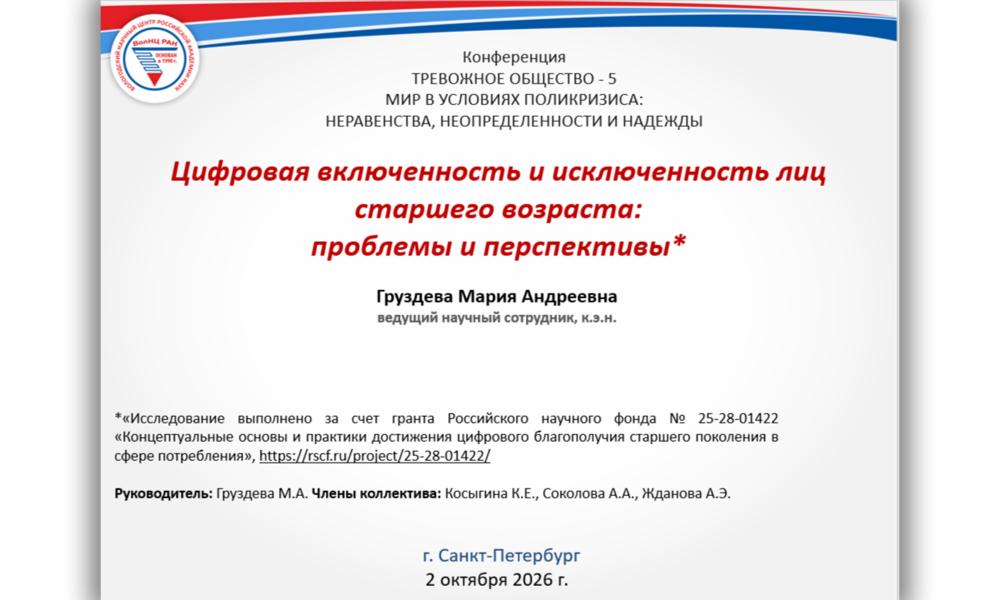
The research results of the VolSC RAS, obtained as part of the implementation of Russian Science Foundation grant No. 25-28-01422 "Conceptual foundations and practices for achieving the digital well-being of the older generation in the field of consumption", were presented at the section "Digitalization of the daily life of the older generation in the era of polycrisis: contradictions, barriers, possible solutions".
M.A. Gruzdeva's report "Digital inclusion and exclusion of older people: problems and prospects" is based on an analysis of such factors as the availability of technical skills and access to the Internet, the degree of involvement in the digital environment, the ability to use online resources to meet social, cultural and everyday needs, as well as a subjective sense of belonging to the modern information society. The society is shown the differentiation of older people. Three clusters of the population over the age of 50 have been identified, two of which have significant or partial involvement in digital interactions, and one cluster of the elderly who choose the "right to opt out" from participating in a large-scale digital transformation. For each of them, the socio-demographic factors of falling into a particular group are analyzed using statistical methods. Using data from qualitative sociological observations (focus group studies), the results were discussed from the perspective of the consequences of the current differentiation for public authorities, social and commercial service providers.
You can find out more about the results of the research on the grant in the works of the author's team.:
1. Sokolova, A. A. Digital consumption in pre-retirement and retirement age: practices, risks, negative consequences / A. A. Sokolova, M. A. Gruzdeva // Factors and mechanisms of demographic development: Collection of scientific articles. Yekaterinburg : Institute of Economics, Ural Branch of the Russian Academy of Sciences, 2025, pp. 368-380.
2. Kosygina K. E. Digital well-being of representatives of the "silver" age: opportunities and risks // Scientific result. Sociology and management. 2026. Vol. 12, No. 1. pp. 185-199.
3. Gruzdeva, M. A. Criteria of digital well-being of the population: status and problems / M. A. Gruzdeva, A. N. Gordievskaya // Economic and social changes: facts, trends, forecast. – 2025. – Vol. 18, No. 5. – pp. 187-199.